
How to Trim Your Dog's Nails Without the Struggle
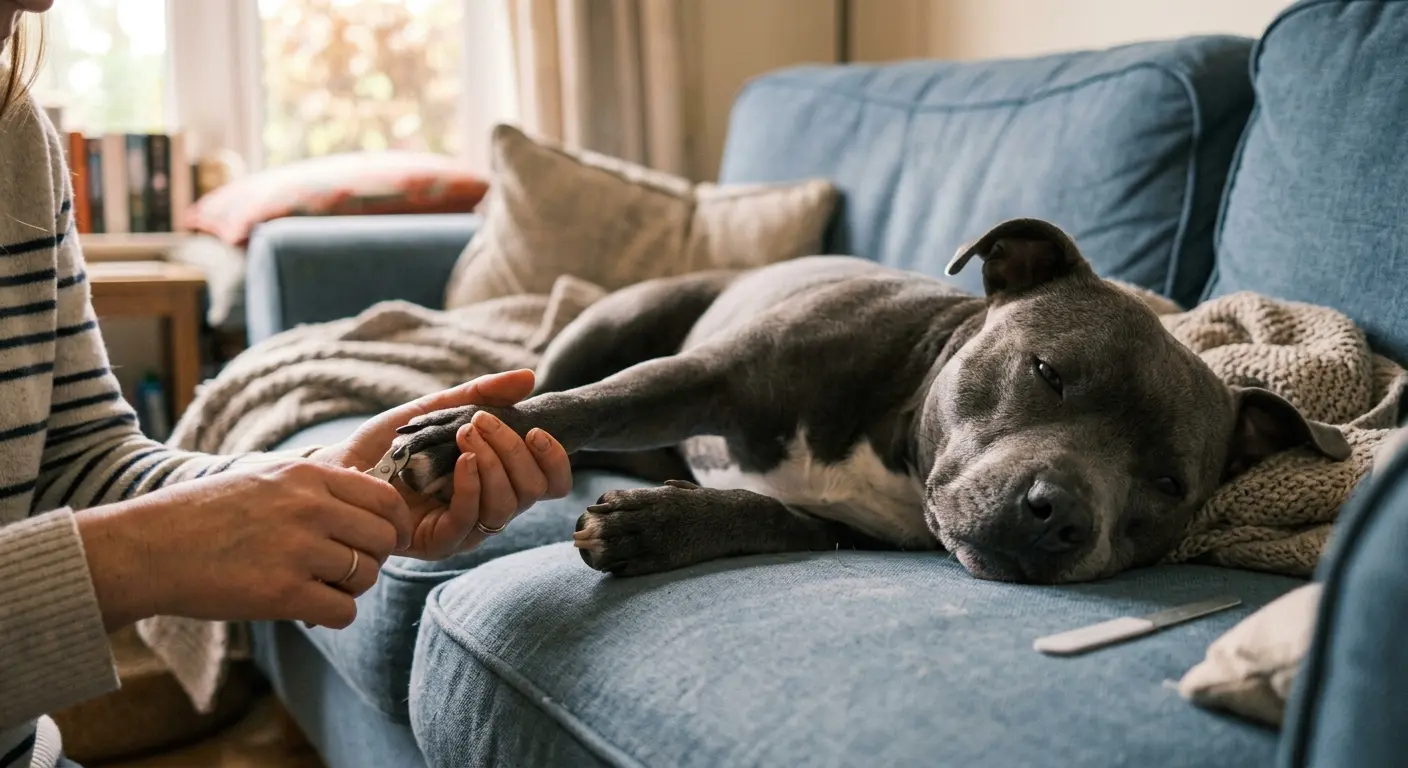
If trimming your dog’s nails feels like wrestling an octopus, you’re not doing it wrong — you’re just doing it with a dog who was never taught that paw-holding is safe. The good news: the trimming itself takes about ninety seconds. The skill worth learning is everything around it — reading the nail so you don’t hit the quick, and building a dog who lends you a paw instead of yanking it back.
Why it actually matters (it’s not just tidiness)
Overgrown nails aren’t a cosmetic problem. When a nail is long enough to touch the floor, every step pushes it back into the nail bed, which is genuinely uncomfortable and, over months, changes how your dog stands and moves — splayed toes, sore joints, a reluctance to walk on hard floors. A nail left far too long can curl into the pad.
The rough guide: if you can hear clicking on a hard floor, they’re too long. Standing still, the nails shouldn’t touch the ground.
Meet the quick — the one thing you’re avoiding
Inside every nail is the quick: a core of blood vessels and nerves. Cut into it and it hurts and bleeds. Nick it once and many dogs remember, which is how a five-minute job becomes a lifelong fight.
- Light/clear nails: the quick is the pink part you can see through the nail. Stay a couple of millimetres clear of it.
- Dark/black nails: you can’t see it from the side, so you go by the cut surface instead. Trim a sliver at a time and look at the end of the nail after each cut. You’ll see a chalky, pale ring. Keep going and a small dark dot appears in the centre — that dot is the front of the quick. Stop there.
The quick also recedes as the nail gets shorter. If your dog’s nails are badly overgrown, the quick has grown out with them; you can’t fix it in one session. Take a little every week or two and the quick retreats, letting you get them shorter over time.
Clippers or a grinder?
Both work. It comes down to your dog and your nerves.
| Clippers (scissor-style) | Grinder (rotary file) | |
|---|---|---|
| Speed | Fast — one cut per nail | Slower, file down gradually |
| Quick risk | Higher if you misjudge | Lower — you sneak up on it |
| Downside | The “crunch” startles some dogs | Noise + vibration startle others |
| Best for | Confident trimmers, most nails | Thick nails, or nervous cutters |
Whichever you pick, keep styptic powder (or cornflour in a pinch) within reach before you start — it clots a nicked quick in seconds. Skip guillotine-style clippers for anything but small dogs; scissor-style give you more control.
The 90-second trim, once your dog is on board
- Hold the paw gently but don’t grip — pressure makes dogs pull away. Use a thumb on top and a finger on the pad to steady one toe.
- Cut at a slight angle, following the natural shape of the nail tip, taking small slivers rather than one big bite.
- On dark nails, check the cut face after each sliver and stop at the first dark dot.
- Don’t forget the dewclaws — the “thumb” nails higher up the inside of the leg. They never touch the ground, so they never wear down and can curl into the skin if ignored.
- Pay after every foot — a treat, a fuss, a moment’s break. You want the whole thing to predict good stuff.
Only ever cut what you can clearly see is safe. When in doubt, take less. Two under-ambitious trims a week beat one that draws blood.
If your dog hates it: teach the paw, then the tool
This is the part most guides skip, and it’s the part that actually fixes things. If your dog already dreads the clippers, don’t push through it — you’ll only deepen the fear. Rewind and rebuild it as a game where a paw predicts chicken.
Work in tiny steps over days, staying under the threshold where your dog gets worried at each one before moving on:
- Touch a paw, treat. Just that. Reach down, touch a foot, feed. Repeat until a paw-touch makes them look happily for the treat.
- Hold the paw for a second, treat. Build up to a few seconds.
- Show the clippers, treat. The tool appears → chicken happens. Put it away between reps.
- Touch the nail with the clippers (no cut), treat.
- Clip one nail, jackpot — several treats, then stop for the day. One nail is a win.
The order that matters: the tool or the touch comes first, then the food — so your dog learns “clippers mean chicken,” not “chicken means clippers are coming.” Let them walk away whenever they like; a dog who knows they can leave is a dog who chooses to stay.
Two positions help nervous dogs: let them lie on their side relaxed, or trim while they lick a spoon of something tasty (wet food, plain peanut butter) smeared on a mat or a wall.
When to see a groomer or vet instead
There’s no shame in outsourcing this. See a professional if:
- The nails are so overgrown they’ve curled or the quick is very long.
- Your dog has a real fear response — panic, snapping, freezing — that isn’t easing with slow work.
- You nicked a quick and the bleeding doesn’t stop within a few minutes of pressure and styptic powder.
- Your dog has a health condition affecting clotting or mobility.
A vet can also do a “short trim” under sedation to reset badly overgrown nails, after which upkeep is easy.
Keep it small and regular
The dogs who tolerate nail trims aren’t born calmer — they’ve just had hundreds of boring, rewarding little sessions where nothing bad happened. The Ruffy app builds that kind of handling into short, force-free routines — cooperative-care exercises that teach your dog to offer a paw and stay relaxed for grooming, the vet, and everything else life asks of them.
Trim a little, pay well, and stop while it’s still easy. A minute today saves you the wrestling match next month. 🐾
Keep reading
How to Stop a Dog Chewing Everything (Force-Free)
Chewed shoes, table legs and TV remotes? Destructive chewing is normal dog behavior with a fixable cause. Why dogs chew, how to redirect it, and why punishment backfires.
How to Teach Your Dog to Lie Down (the 'Down' Cue)
Down is the calm off-switch of dog training — for the vet, the café, the front door. Here's the force-free way to lure it, fade the treat, and add the word so it actually holds.
Why Does My Dog Eat Poop? (And How to Stop It, Kindly)
It's gross, but it's common and rarely a sign of something sinister. Here's what the science says about why dogs eat poop — their own, the cat's, or a horse's — plus the vet checks worth doing and the force-free way to stop it.